|
The Journal of Ashok Sharda A Date With CHILIKA: March 7, 2005
04/04/2005 09:34 p.m.
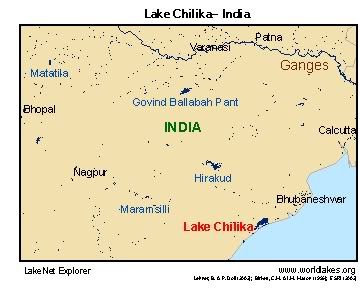 The Lake Zoomed In The Lake Zoomed In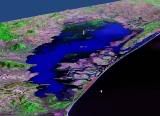
(worldlakes.org and pbase.com/hcarlsen/india2005maps)
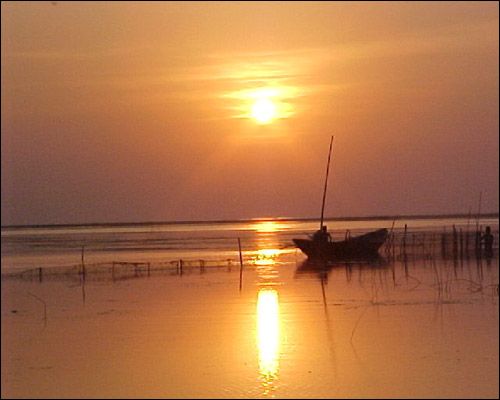
The water is muddy, a bit perturbed, and this huge lake looks just like a sea. We can outline, on the horizon, the distant islands dotted with coconut and palm trees. Our boat is an ancient vessel turned into a makeshift motorboat, its boatman likewise appearing ancient though not wise, but rustic and uncouth. We, Rula and I, are here to watch sweet-water dolphins swim and play, and then to ride to the point where this lake meets the sea. This point is known as 'the mouth'. I wonder how this lake water remains sweet though it meets the sea at a certain point? Maybe the different densities of the water keep them separated, I think to myself.
(chilika.com and verobeachsold.org)
This is the famous CHILIKA LAKE, a shallow marshy lake and the largest lagoon on the eastern coast of India and the subcontinent. Chilika Lake is roughly pear-shaped and fluctuates in size according to the dry and wet seasons. Varying in length between approximately 600 and 1200 square kilometers, its width spans about 32 km at its broadest. Nalaban, one of its biggest islands, is a 10km marsh which is submerged underwater during July and March, but is a major feeding and roosting habitat during the winter for over a hundred species of migratory birds who arrive in October from their temperate breeding grounds. These birds include a few species of Australian flamingos, over a dozen species of ducks, and several migratory birds from as far away as Siberia and Mongolia. Due to the varying degrees of salinity in different parts of the lake, the fauna is interestingly diverse, with a variety of animals adapting to a marine (or riverine) existence in order to survive in different parts of the lake. Animal life recorded in the lake ranges from microorganisms to a vast variety of fish, which together sustain the migratory birds population in the wintertime.
A few estuarine turtles and snakes are found here along with species of dolphins, otters and several rodents, bats and sloth bears on the hills. Around 158 species of fishes and prawns have been recorded so far. In 1917, a rare reptile, the limbless skink (a type of lizard) was discovered for the first time in the loose soil of the Barakudia Island.
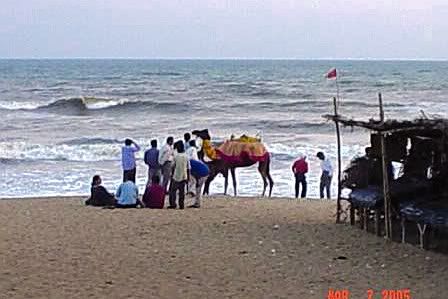
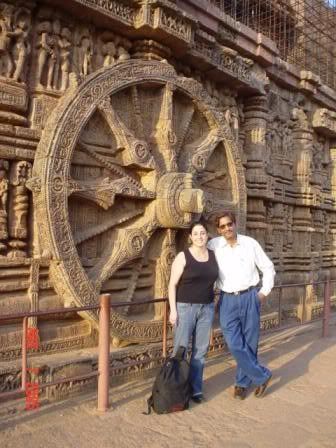
I bring Rula here after having visited the famous SUN Temple of the thirteenth century called Konark Temple. This temple is widely known not only for its architectural grandeur, but also for the intricacy and profusion of its sculptural work. The entire temple has been conceived as a chariot of the sun god with 24 wheels, each about 10 feet in diameter with a set of spokes and elaborate carvings. Seven stone horses drag the temple. Guarding the entrance are the statues of two lions (symbol of wisdom), atop and crushing two elephants (symbol of wealth), which are in turn atop and crushing two men (symbol of idiocy). This temple we visited after having spent some time on one of the largest beaches in India called PURI.
 And And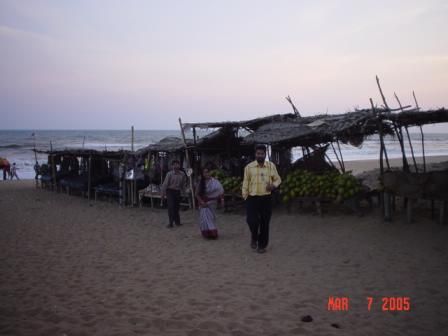
A lovely scene at Puri beach
 Longer View Longer View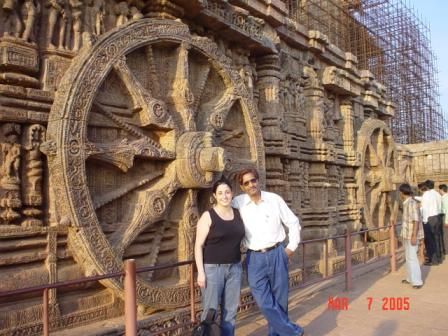
Rula and Ashok at the Konark Sun Temple - One of 24 Wheels - 2 each of 24 dedicated to one Zodiac sign, in this case, Pisces
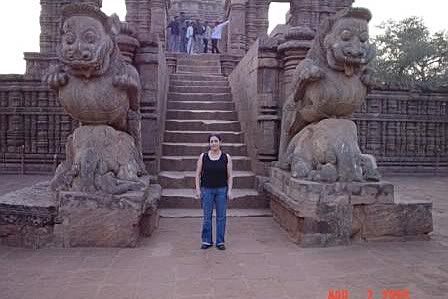
Rula at Konark Sun Temple Entrance - Two Lions guard the entrance (symbol of wisdom),
crushing elephants (symbol of wealth),crushing men (symbol of idiocy)
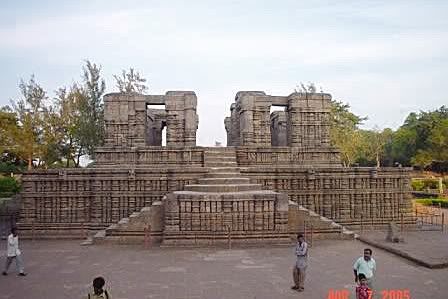 Cut View... Cut View...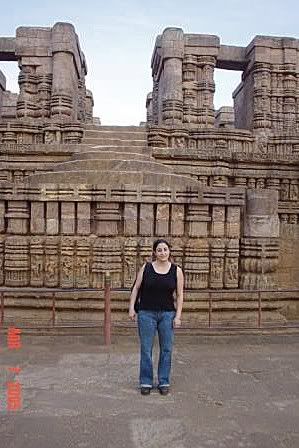
Across from the Sun Temple lies this beautiful stage built exclusively for women to dance to their Gods.
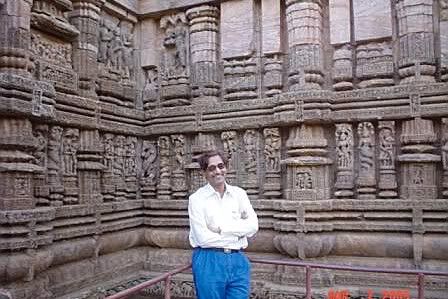
Ashok with a smile at Konark
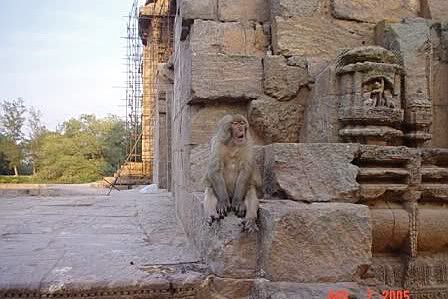
One of the many monkeys who call Konark Sun Temple their home. He sits above and before a group of men about to make his emotional speech
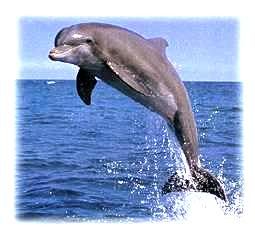
It is almost noon on this 8th of March, 2005, a time, we are told, is not ideal for dolphin watching as the bright sun and heat keep the dolphins from appearing on the surface of the water. Over and above, it is a bit windy, again a factor not conducive for dolphins to appear on the surface. To our pleasant surprise, we do see dolphins in large numbers despite the bright sun and wind, though their appearances are infrequent and short. In the beginning we spot only one dolphin at a time, but subsequently they oblige us by appearing in twos and then threes and fours, shoulder to shoulder, rolling over and over and over again on the surface, swimming together in perfect harmony. But we do miss those jumps wherein dolphins virtually stand on their tails, their bottlenoses facing the sky.
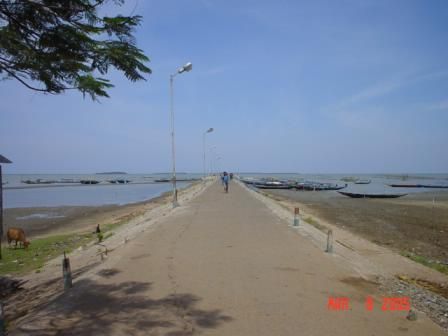
Walking on the dock towards the boat that will take us dolphin-seeing with a final destination to the mouth
The dolphins appear and disappear on the surface of that sweet water muddy lake so fast that no sooner is Rulas attention attracted and her camera set to capture them do they simply disappear out of sight. After many unsuccessful tries, Rula thinks of a trick when she finds an opportunity: four dolphins appear together in one particular spot, rolling over in perfect unison. Rula decides to follow them through the eyes of her camera and click on any cue. A dozen clicks on her part result in two clear pictures and we are so happy with these captures.
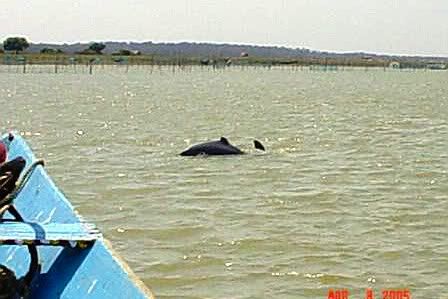
We spot one dolphin swimming around alone
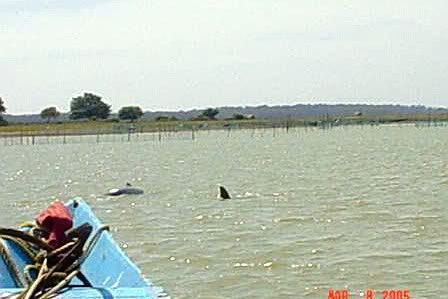
Here we spot two dolphins traveling together
After our rendezvous with the dolphins, our makeshift motorboat turns toward the spot where the lake meets the sea. An hours ride brings us to what is known as the mouth of the sea where a shallow embankment separates CHILIKA lake and the Indian Ocean. Still, despite being separate entities, they did meet externally as well as internally and the water, their essence, did mix. The merging of lake and sea we confirm through the documentary film we later view in the museum of the CHILIKA Development Authority. Over time, this mixing of saline and sweet water has increased the marine life many folds. Bio-diversity not only improves the quantity of sea creatures, but also the quality. (From our point of view we need the quality and not the quantity. Ha! Ha! Ha! )
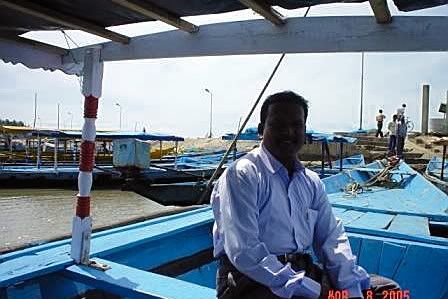
Our honorable guide, Mr. Jena, a school teacher
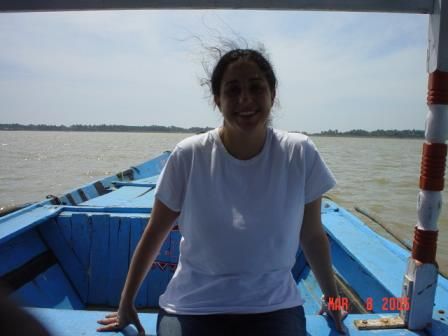 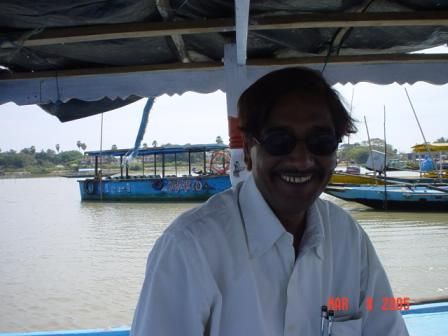
Rula and Ashok on the ancient motorboat on the way to the mouth
When the boat stops at the mouth and we land on a piece of landmass, the lake lies behind us and on our left side with many lush green islands on the horizon. The sea, with its incessant clamoring waves, is in front of us infringing the embankment separating it from its beloved CHILIKA and rising with a landscape on our right side with casuarinas planted not very long ago on the scale of time. Here there were few vendors selling coconut water, fried fish, and tea for the visiting tourists, although the area looks almost deserted, as if visitors are few and far between.
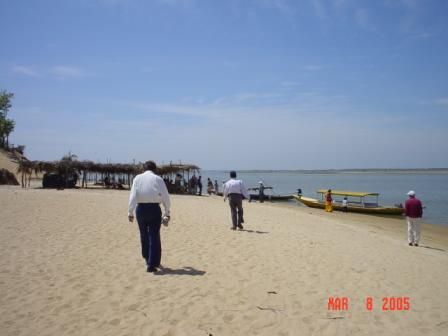
On the way back to our makeshift motorboat we decide we will make a stop at the vendors' tents
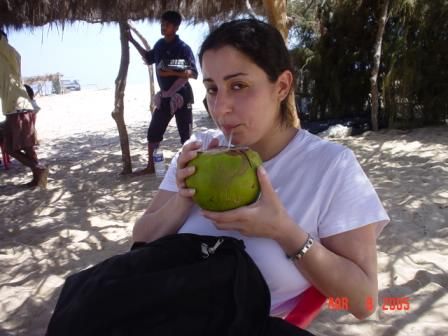 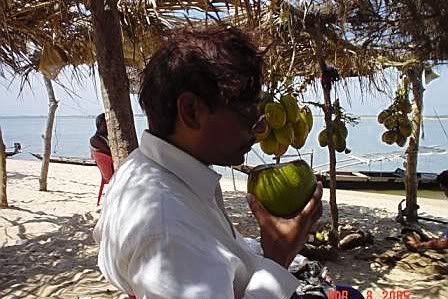
Rula and Ashok sitting under the vendors' tent enjoying the cool refreshing milk of a coconut
We sit beneath the tents and sip on cocunut milk on our way back from visiting the mouth's beach. But on our way in, about one hundred yards past the vendor's tents, we walk towards the the sea, and what a landscape lays before us! On our right side is a huge desert-like beach, yes beach, which looks just like a huge desert with rolling sand dunes! Instantly, I decide that this could be the largest beach on earth and a site that would attract millions of people every year if only those at the helm of affairs knew how to sell it as those who know how to sell the Grand Canyon do. (Ha! Ha! Ha!). The beach is so gigantic that I wonder how people swarm on other tiny dirty beaches while here we were just three people enjoying such vast beauty - me, Rula, and our honorable guide, a school teacher, Mr. Jena, who is accompanying us by the courtesy of my friend Mr.Panigrahi, the director of the regional TV station and our host in this eastern part of India.
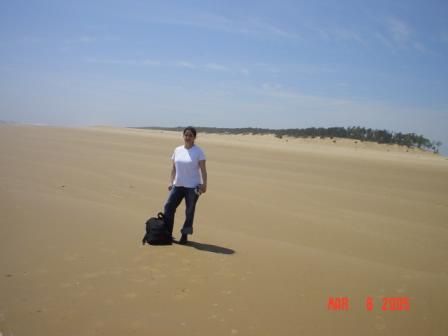
The beach looks like a desert when one does not look to the shore, for to the right the dunes stretch out as far as the eye can see
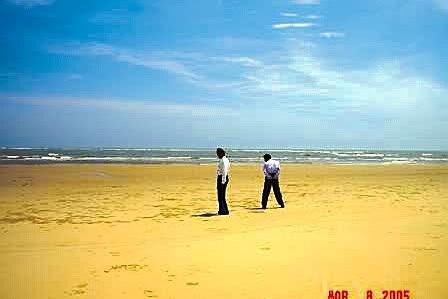
Ashok and Mr. Jena walk along the desert-like beach - The mouth where the ocean meets Chilika Lake Lagoon
It is here, as we stroll the dunes of the beach, that I find a prized gift from nature. I upturn a flat, yet somewhat curved piece of a curious-looking object that turns out to be one side of a sea turtles shell. I dig out yet another piece and find the bone structure of its neck. Finally, I find my gift a few feet away his skull, perfectly intact and huge! I wonder how I will carry it from here back to my home where I will display it in appreciation? Mr. Jena, my honorable guide, comes to my aid by offering me a newspaper he is carrying tucked under his arm. We wrap it up and carefully put it in Rulas backpack for safekeeping until we return to our hotel. By the way, I later gift this skull to my friend back in Bhubaneshwar on a promise that he will try to find one for me, and in turn, gift it to me.
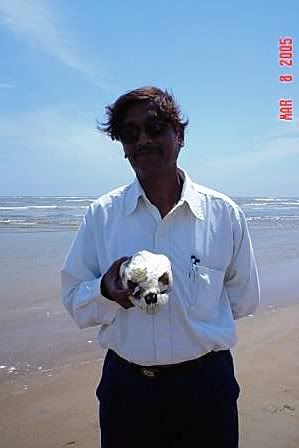
Ashok finds the remains of a turtle and shows off the skull which remains in excellent condition, just a few feet from the broken shell
While reading on dolphins I came across this poem by Horace Dobbs:
Pushing through green waters
Symbol of joy
You leap from the depths
To touch the sky
Scattering spray
Like handfuls of jewels
Not caged by union rules
Unfettered by sales targets
No trains or planes to catch
Your time is set by the flow
Of the sea's tides
And the moon's glow
You give us images of ecstasy
That we lock away
Behind the doors of memory
For quiet moments
when released from our possessions
We dream of a freedom like yours
| Member Comments on this Entry |
| Posted by Rula Shin on 04/04/05 at 11:01 PM I remember it as if it were just yesterday... |
| Posted by Chris Sorrenti on 04/05/05 at 06:01 PM Fabulous photos/travel log Ashok & Rula. I hadn't realized that (you) Rula had visited. |
| Posted by Laura Doom on 04/09/05 at 11:30 PM Thank you for such a descriptive and irreverent commentary Ashok :) I especially enjoyed the image of seven stone horses dragging the temple behind them, and the symbolic insignificance of men in traditional architectural design. I can't begin to imagine the diversity of natural & social environements you have access to there, but I'm priviledged to have enjoyed your appreciation of a few of them here :> |
Return to the Library of Ashok Sharda
|