|
The Journal of Ashok Sharda Bini Falls in Love with Rula : March 10th, 2005
04/13/2005 10:21 p.m.
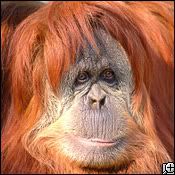
An orangutans face up close, like his namesake,
he looks like an old man in the woods (www.animaldiscovery.com)
Oh! Dont be surprised, Bini does fall in love with Rula, and I am not surprised. I watch Rula rising in love, trusting, expressing her humility and affinity and feeling sad when she has to leave Bini. And Bini? She is as sad as Rula is, as any human being can be, watching Rula leave.
Bini, she is the great grand mom of the homosapiens, our immediate ancestors. Bini! Bini! Bini! She appears on the third call of our host Mr. Kamal Purohit, the assistant conservator of the Nandan Kanan zoological park. From a back door that leads out into an open enclosure where the visitors watch her huge form in awe, she walks slowly into the cage from where she is usually fed. She looks lonely, tired, and sad. She is 26 years old, and Mr. Kamal informs us that they are searching for a suitable mate for her, though the only male they recently negotiated as her companion died in his own zoo before being transported to Binis secluded home.
The moment she willingly enters her cage, we easily make out that her attention is concentrated on Rula. She extends her large hands through the iron bars as an offering to Rula, but for reasons of her bulk and strength, our host restrains Rula from responding.
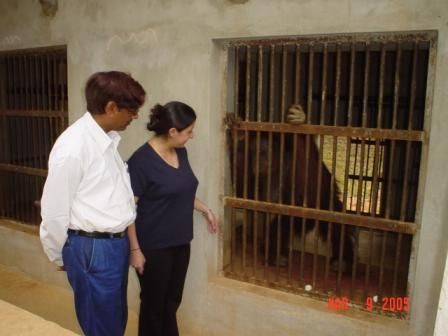
Ashok and Rula approach Binis cage. Bini stares at Rula from the very beginning
You can touch and caress her, he says, but dont get too close.
How about me? I ask eagerly.
Oh! Well, she may treat you as mice in the rice, so maybe youd better maintain a safe distance. Ha! Ha! Ha!
But I do caress her, though cautiously and maintaining a safe distance. She continues to extend her long arms through the bars to Rula, throwing her kisses by extending her pouting wide lips in Rulas direction, wanting her to come close, wanting her to touch and hug. At this point, Binis lunch arrives and Mr. Kamal offers her a boiled egg that she peels, breaks, sucks out the yolk, and then throws away. Mr. Kamal picks up the egg white from the ground and gives it back to her to eat, though time and again she refuses to do so and simply throws it back down on the ground. Soon after, when Mr. Kamal offers her milk in a large steel cup, she refuses to drink. Mr. Kamal seems to understand the cause of her refusal to eat and asks Rula to feed her. To our surprise, Bini begins to drink readily and heartily all the milk from the cup!
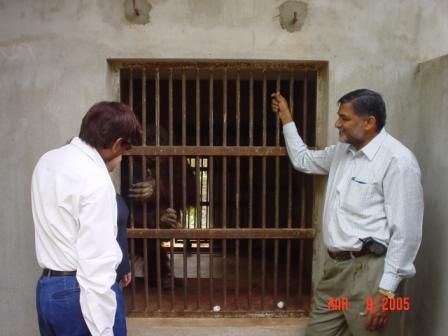
Before lunch arrives, Bini begins to extend her hand out endearingly
Bini continues to attract Rulas attention by constantly extending her lips and expressing her affection, and affinity.
Why is she so attracted towards Rula and not me? I ask Mr. Kamal.
Well, this has something to do with her childhood association, he explains.
She was brought here from Australia under an exchange program and for this reason has always been more at ease, more at home with fair-skinned people.
Ha! Ha! I laughed within. She is so dark and like most of Indians, she too is afflicted by the typical Indian concept (complex) of beauty, wherein the fairness of the skin is the criterion for pronouncing someone beautiful, and dark ugly. Hahahahahaha! Well, I reiterate my decision to keep a safe distance from her as I realize she may feel irked at my attempts to attract her attention. She may treat my action of endearment as a cause of distraction. I look at her huge hands and feel safe from that distance though I just cant resist caressing her one more time, though I remain alert and watchful of her reaction.
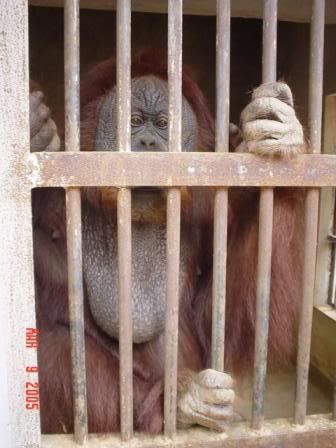
After lunch, Bini gets as close to us as she possibly can, and we too get as close as we can
Incidentally, Rulas camera cells exhaust at this very moment and becomes a source of great frustration. Somehow, she manages to take a picture or two of this meeting with Bini, though we are unable to capture the moments of love and affection between herself and this grand and beautiful creature. As we begin to leave, Bini follows us to the outside enclosure. She looks so sad and so too does Rula since they both know that they have to part and these moments of love and affection, these moments of complete trust between man and animal will soon become a thing of the past, though an ever living association. Before getting into our car, we stop for a while to say our final goodbye.
Bini! Bini! Rula goes on calling her name, and Bini, in turn, continues to extend her lips in loving gesture. When we finally part with her, I watch Bini slowly walk back to her room as we climb back inside our car. I dont think I can ever forget this grand old lady. She is so graceful, so endearing, and so human. A great sadness envelopes us.
PS: When I inform Rula of my intention of documenting Experience Bini
by way of this JE, this is how she remembers her:
Sweet, lonely, sad little Bini. No, she wasn't little, but she did give one the sense of wanting to love her and take care of her, and in that sense she felt little...like a child, yes...a child a grandmother...isnt it odd how similar we become at these stages of life? We are, at these stages, both childlike and wise at the same time. Well, it was her eyes Ashok. She was looking at me as though she were asking me something, asking me to stay...asking for help, for love...asking for our moment together to last beyond what all moments with others have lasted. But she was as wise as she was childlike, and in the end she knew what would be. She knew that we would leave her, and that her wide enclosure was the smallest little cage in the whole world. But ashok, no one could ever imagine Bini as we saw her, I mean her eyes...so sad and lonely. I love her. I wish I can be with her again.
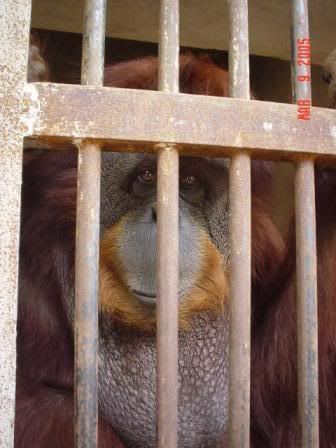
Binis sad and lonely eyes. This is the look we remember most
PS: I read this humorous piece somewhere online:
Orangutan by Grandpa Tucker
We read about the monkey,
We read about the chimp,
But info on the orangutan
Is really very limp.
Their eating habits, where they live,
What causes them to smell?
Research ignores the orangutan
Because it's hard to spell.
It wont be out of place here to add some basic information about this
endangered human ancestors, the orang-utan called person of the forest
by local people and the neglected ape by many scientists.
Orangutans covered with long dark brown hair have a large bulky body, a thick neck, very long strong arms, short bowed legs, and no tail. They are almost as huge as Gorillas. Orangutans have senses very similar to ours, including hearing, sight, smell, taste, and touch. Their hands are very much like ours as well, and they can grasp things with both their hands and their feet. In addition, Orangutans make wonderful mothers, only human children stay longer with their mothers than orangutans!
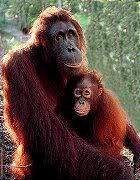
Princess and son Pan (www.orangutan.org)
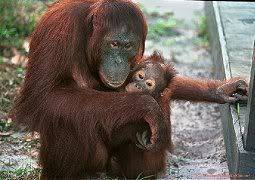
Davida and son David (www.orangutan.org)
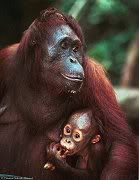
Ronnie and her infant (www.orangutan.org)
The largest males have an arm span of about seven and a half feet. They eat both plants and animals, although plants comprise most of their diet. Fruit is their favorite food as well as leaves, seeds, tree bark, plant bulbs, tender plant shoots, and flowers. Orangutans don't even have to leave their tree branches to drink, they drink water that has collected in the holes between tree branches.
Orangutans are very intelligent. They have been known to use found objects as tools. For example, they use leaves as umbrellas to keep the rain from getting them wet. They also use leaves as cups to help them drink water. Each evening, orangutans construct a "nest" in the tree branches for the night in which they will curl up and sleep. These nests are made out of leaves and branches and are shared by a mother and her nursing offspring. Sometimes, the orangutan will use a leaf as a "roof" to protect itself from the rain.
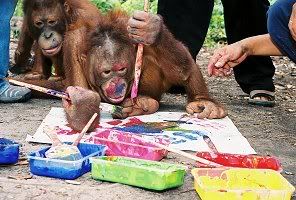
Having fun painting and even more fun getting it all over! (www.orangutan.org)
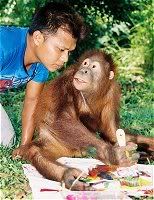
What do you think of this? (www.orangutan.org)
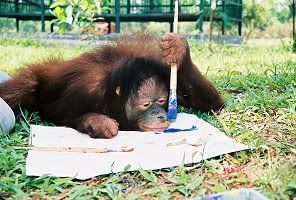
Concentrating REALLY well. Art is hard work! (www.orangutan.org)
Orangutans usually move by swinging from one branch to another. This mode of transportation is called brachiating. Orangutans can also walk using their legs (though they rarely do), and do not swim.
Orangutans live about 50 years in captivity, whereas their life in the wild spans only about 30-45 years. Like most animals, they live longer in captivity.
| Member Comments on this Entry |
| Posted by Rula Shin on 04/14/05 at 02:14 AM Reading this I thought of Bini all day long...her face and eyes are forever etched in my mind, her outstretched arms and hands and pouting lips forever reaching for my heart. A beautiful reminder Ashok. Really beautiful. |
Return to the Library of Ashok Sharda
|